Jarl Thryggvi
When the Cold Breathes A Ragnar Stormbringer Tale A Ragnar Stormbringer TaleJarl Thryggvi is a displaced warrior and frontier ruler whose personal history explains the formation of the northern settlements and whose hill-fort becomes the central refuge during the Wight crisis. Driven from his original lands after falling into conflict with one of the northern kings, he leads his family, servants, loyal warriors, and their families eastward into a region already marked by war and hardship. There, his authority grows from exile into accommodation: a forest-dwelling tribe accepts his arrival and, in a peaceable manner, agrees to place itself under his rule.
Exile and Frontier Rule
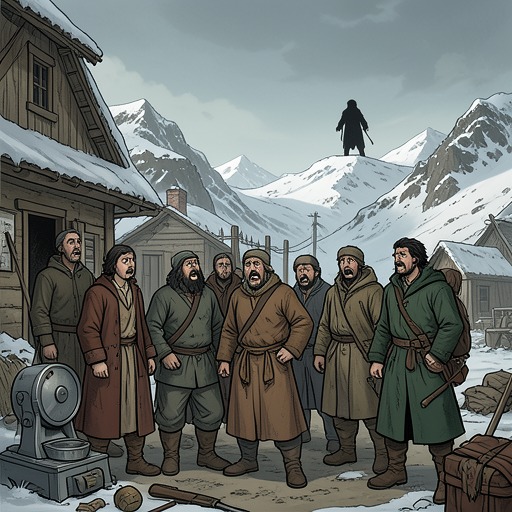
Thryggvi’s political identity begins with loss. Once in conflict with a northern king, he is forced to abandon his lands rather than remain within the old order. His eastward migration is not an isolated flight but a collective movement involving relatives, dependents, armed followers, and their families. The group therefore arrives as the nucleus of a new settlement rather than as a solitary band of refugees. The people already living in the region have endured their own war and hardship, and their desire to end a longstanding plight makes them receptive to the displaced jarl. Their acceptance gives Thryggvi rule without a described conquest; he becomes their leader through consent and practical alliance.
Over the following years, his followers and the tribesmen establish several villages and homesteads. The resulting domain is a mixed frontier society, formed by migration, local incorporation, and shared dependence on a difficult landscape. Thryggvi’s lands also occupy a strategic position. The settlements become a stopping point for northerners preparing to cross the river-crossed grasslands to the south, offering rest and sustenance within the frigid wilderness. His rule thus combines local governance with control of a route used by travelers moving between the northern lands and the southern grasslands.
The Hill-Fort and Its Defensive Order
The hill-fort is the material expression of Thryggvi’s authority. Built at the center of the area under his rule, it occupies the broad summit of a large hill and is surrounded by a ditch, a high earthen rampart, and a stout wooden palisade. Its cramped interior contains small timber huts, animal pens, storage pits marked by slanted roofs and underground entrances, and entryways dug below ground level. The site was originally constructed as a refuge for the villages and homesteads during wartime, so its defensive purpose predates the Wight crisis. Thryggvi has improved an older fortress site, making use of an enclosure that reaches back to the time when the local tribe first dug its outer ditch and formed its earthen rampart.
The fort therefore carries two histories at once: it is an inherited tribal stronghold and the reorganized center of the jarl’s newer domain. When the Wights emerge from the barrows and threaten the settlements, that old defensive design becomes the population’s only viable protection. Men, women, and children flee through the snow from the villages and homesteads, carrying whatever food and possessions they can gather. The fort receives them in successive waves, including isolated stragglers from the outermost dwellings. Its purpose changes from a reserve against ordinary war into a sealed refuge against creatures whose sole desire is to slaughter the people outside.
The Wight Crisis and Emergency Leadership
When the disappearances begin, Thryggvi is already an aging ruler responsible for a scattered population. Eight men have vanished from the surrounding villages over several weeks, with neither witnesses nor an identified cause. Cnut and others discuss forming a large armed search party, but fear prevents anyone from setting out even after several more days. Cnut comes to the jarl’s homestead seeking an urgent conversation with Ragnar Stormbringer, and the old jarl initially wants to dismiss him. Ragnar agrees to hear the account, linking Thryggvi’s domain to the investigation that will uncover the danger.
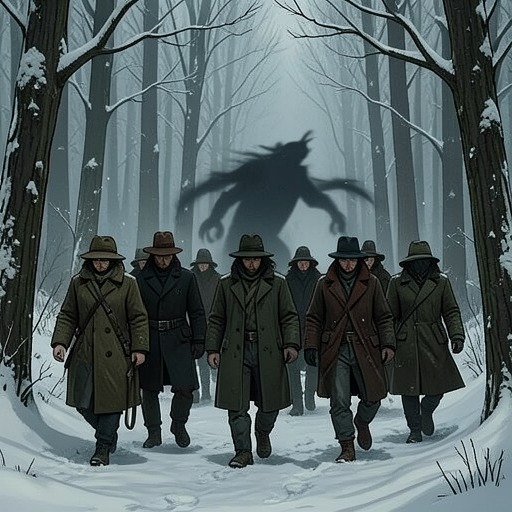
After Ragnar discovers the barrows and reports the beings emerging from them, the threatened community identifies the attackers as Wights rather than ordinary draugr or ghouls. The fortress then becomes the scene of an emergency state in which ordinary movement is suspended and survival depends on collective discipline. At the gate, Ragnar Stormbringer personally examines the late arrivals to determine whether they are human before allowing them inside, because frightened defenders might otherwise spear or hack apart a lone figure appearing through the snow. Once no further villagers arrive for a time, Ragnar commands that the gates be shut. The timber gateway is barred, guards are posted on the wall-walk in every direction, and the people inside wait while the Wight horde gathers beyond the ditch.
These actions are performed in Thryggvi’s stronghold, but the immediate authority belongs to Ragnar, whose combat experience allows him to organize the defense when panic threatens to overwhelm the settlement. The arrangement reveals both the value and the limits of Thryggvi’s rule: he has created the place capable of sheltering his people, yet the crisis requires an outsider to impose the first decisive commands.
Relations with Ragnar Stormbringer
Thryggvi’s relationship with Ragnar is initially one of host and guest. Ragnar chooses not to begin a southward journey during the depths of winter and remains for a time at the jarl’s homestead. The decision is partly practical and partly pleasurable: the settlement provides warm fires, rye-grain drink, honey, pickled cabbage, food, and companionship, allowing Ragnar to postpone the dangers of the northern wilderness until winter has eased. Thryggvi’s hospitality therefore places Ragnar within the jarl’s social world before the supernatural emergency transforms him into its principal defender. Ragnar also feels indebted to the settlement. After finding the remains of Heimval, a settler killed by a Mayak, he resolves to avenge the dead man and aid the settlers whose leader has taken him in during the harshest stretch of winter.
Thryggvi’s generosity thus becomes part of Ragnar’s motive for remaining engaged with the community rather than simply continuing south. Once the Wights surround the fort, Ragnar seeks Thryggvi in the largest hut to discuss the dilemma and search for a means of defeating the pit-spawned creatures. The jarl listens to Ragnar’s report with a spellbound expression after the battle and the wider sequence of events have occurred, receiving the account as both ruler and witness to the preservation of his domain. The available evidence does not show Thryggvi directing the combat himself; instead, it places him as the host whose settlement, population, and inherited fortress are defended by Ragnar’s actions.
An Inherited Stronghold Under Threat
Thryggvi’s domain is repeatedly defined by layers of inheritance. He inherits neither an untouched wilderness nor a simple kingdom. He arrives among a tribe battered by war, is accepted as its ruler, and builds villages with people drawn from different histories. He then governs from a fortress whose first ditch and rampart were made by the tribe long before his arrival, improving rather than replacing the older site. Even the concealed tunnel discovered by one of the local tribesmen belongs to this deeper history. The passage runs from within the fortress to a place deep in the trees and offers a possible route beyond the surrounding creatures, although it is too narrow for a tall man to walk upright and might also provide the Wights with a way inside.
Ragnar recognizes the strategic problem immediately: escape alone would not solve the crisis, because other settlements are many days’ ride away and the people remaining in the fort cannot hold out that long. The tunnel therefore mirrors the fort’s broader condition. It is both protection and vulnerability, a hidden resource and a possible breach, just as Thryggvi’s frontier polity is both a refuge and an exposed concentration of life. The settlement’s history of negotiated coexistence is placed under pressure by an enemy that does not negotiate. Yet the fort’s very existence permits the villagers to assemble, organize watches, close the gates, and endure the surrounding cries. Thryggvi’s lasting significance lies in this infrastructure of survival: exile becomes rule, rule becomes settlement, and settlement becomes the defended human boundary against the dead.